The User at the Center

In the digital realm, user experience (UX) reigns supreme. A website, application, or digital product can be visually stunning, technically flawless, and packed with features, but if it’s not a joy to use, it’s destined for digital oblivion. This is where user-centered design (UCD) steps in, a philosophy that places the needs, wants, and limitations of the end-user at the heart of the design process.
The Rosenfeld & Morville Blueprint for UCD
Peter Morville and Louis Rosenfeld, giants in the field of Information Architecture (IA), have laid a foundational framework for UCD. Their approach emphasizes making information environments intuitive, usable, and aligned with user needs, drawing from principles of both library science and user experience design. They identify key building blocks for user-centered information systems:
Rosenfeld and Morville also champion a holistic approach, often illustrated by the “three circles” model:
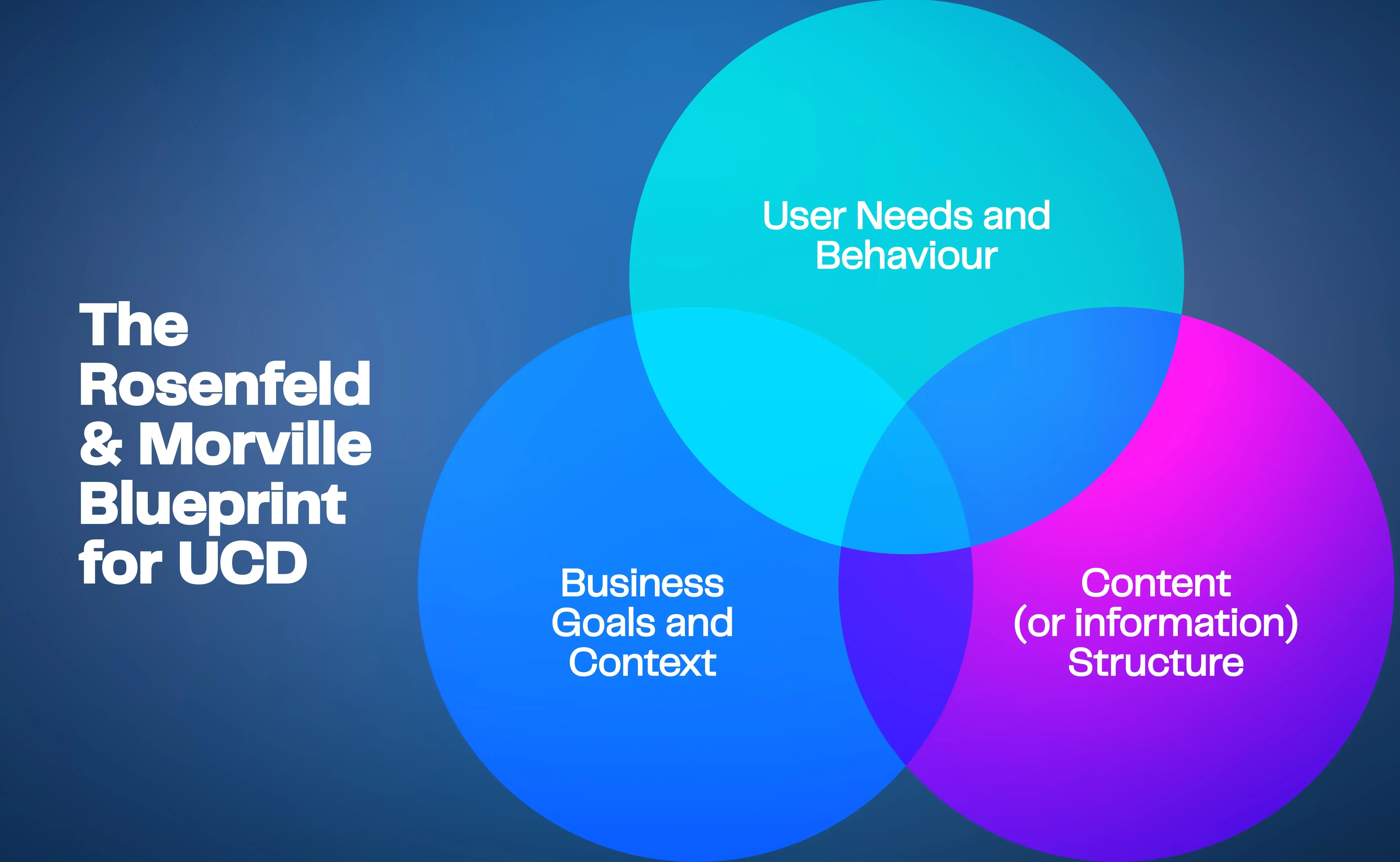
Designers must strike a balance among these three areas to ensure that solutions are not only usable and useful for users but also viable for the business and coherent in terms of content. Their methodology stresses:
UCD in Action: Real-World Examples
Several global brands have successfully applied User-Centered Design (UCD) principles to their websites, resulting in highly usable, intuitive, and engaging digital experiences.
.gifsmall{width:30vw !important;} @media screen and (max-width: 846px){ .gifsmall{width:100% !important;} }

These examples demonstrate that UCD is not only a best practice but a proven strategy for global brands seeking to create websites that are both effective and enjoyable for their users.
In conclusion, Rosenfeld and Morville’s foundations for user-centered design are grounded in understanding users, structuring information environments to meet their needs, and maintaining a balance between usability, business objectives, and content integrity. Their approach is iterative, evidence-based, and strategic, making information architecture a critical discipline in the creation of effective, user-centered digital products.
Source: Nelson, Meggie. Article. “How Web Accessibility Affects Consumers’ Purchase Intention” in SocialNomics Morville, Peter, and Louis Rosenfeld. 2022. Information Architecture for the World Wide Web. Moyers, Stephen. Article. “What These 7 Brands Can Teach You About UX” in ReadWrite.com